Skip to content

Ken’s House of Pancakes

Sun, 17 Mar 2013, 08:25 AM (-06:00) Creative Commons License

So we glided down on Saddle Road in the rain in the dark into the dim, yellow glow of the streetlights of Hilo. We turned right at Hilo Bay, drove by Bayfront Park, passed signs for Liliuokalani Gardens and turned right on Highway 11, prepared for a final climb up toward Kileauea and Ira Ono’s Volcano Garden Arts guest cottage

But we were hungry, and there on the corner we spied Ken’s House of Pancakes (jammin’ since 1971).

Frankly, we didn’t know what we were doing. We were just hungry, and the lights were on, and the parking lot was pretty full, so we pulled in for something to eat. As it turns out, we couldn’t have chosen a better place.

The building is a long, one story diner kind of thing. As I remember it (caveat lector), there’s a bar where you can eat if you’re on your own. And there’s a visible kitchen in the back. And there are many booths where you can sit in groups. We sat in a booth. 

The menu was daunting. There was a little bit of everything: breakfast, omelets listed separately from breakfast, entrees, nite meals, island favorites, desserts… We chose loco moco. Trudy had Ono Loco. I had Corned Beef Hash Loco.

Our eyes went wide when the food arrived, and in no time at all our hunger was … poof. It was the best loco we had ever eaten. It was the first loco we had ever eaten. And if I ever have it again, it needs to be at Ken’s.

Cinder Cone Path

Sat, 16 Mar 2013, 11:31 PM (-06:00) Creative Commons License

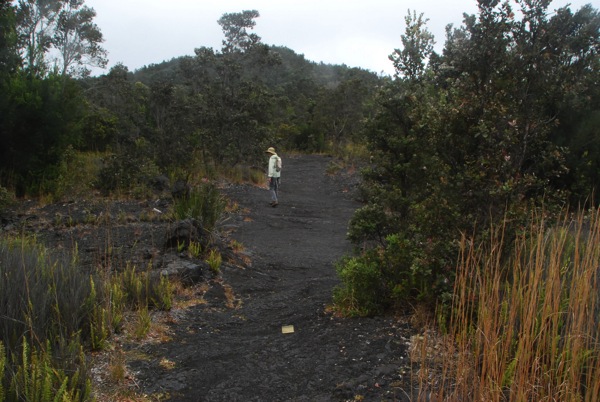
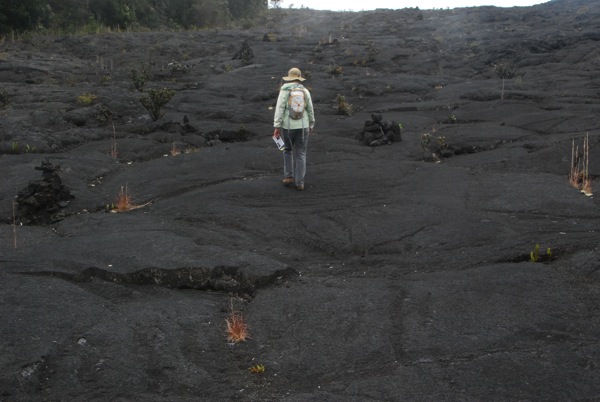
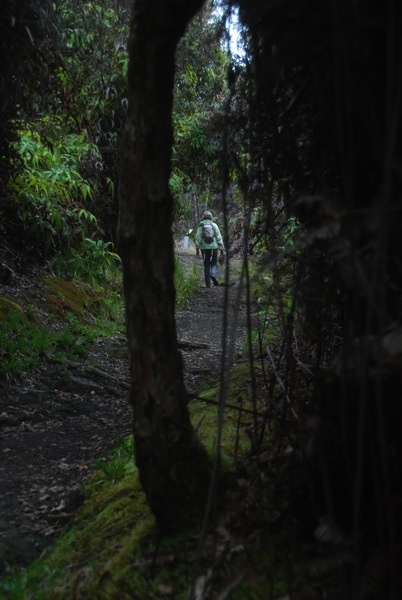
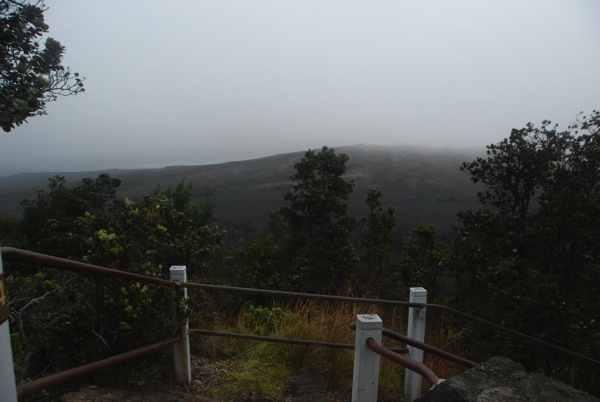
Cindercodepath

The Summit of Mauna Kea

Sat, 16 Mar 2013, 07:34 PM (-06:00) Creative Commons License

1. The Summit

We didn’t stay at the top long. We stopped and gawked at the telescopes sitting on top of the world.

DSC 8357

And we gazed at a tempting trail along a peak leading to one of the orange cinder cones that dot Mauna Kea. 

DSC 8337

There were pockets of snow along the trail, and it led to a summit far off that must have had a wonderful view. But the sun was getting low in the sky, throwing our shadows out onto the slopes.

DSC 8347

And I was getting dizzy from the altitude. And we didn’t want to be crawling back down the volcano in the dark. So we walked around a bit more, and took one more good look at the panorama, the southern view of which included the flanks of Mauna Loa, although we didn’t realize it at the time (which is another story).

DSC 8389

2. Descent

I breathed deeply to try to make the dizziness go away. We got into the Jeep. And we began our descent.

DSC 8370

DSC 8398

On the way down, we passed a Suburban with two flat tires. (What horrible luck, but help was on the way.) And we passed two hikers with packs on their backs, hiking rods in their hands and determined looks on their faces. And there were buses and Jeeps carrying tour groups, clearly ascending to catch the sunset.

We descended back into the clouds and mist and rain, leaving the magnificent blue sky behind.

DSC 8411

Daytime became dusk. And by the time we emerged all the way at the bottom on Saddle Road where we had started this detour, rain was falling, it was night, the fog was thick, and we had zero visibility.

Still, the road was four lanes now with bright yellow stripes down the side — luxurious compared to the drive up from Kona. And we were going downhill so swiftly that we virtually glided all the way to Hilo.

Ascending Mauna Kea

Sat, 16 Mar 2013, 09:29 AM (-06:00) Creative Commons License

Editor’s Note: This fish documents a drive up Mauna Kea. It contains nothing profound. The pictures might or might not hold some interest, but by and large the words are not for general consumption but rather are part of the author’s conceit that years from now it might be particularly nice to read back and reflect upon that which might otherwise have been lost to old age oblivion which even now approaches. Feel free to skip as always but here in particular.

1. Can We Go Up?

There was a road that continued beyond the parking lot of the visitors’ center.

“Can we drive up?” I asked the woman at the counter. 

“I’ll let you take this one,” she said to a rugged, ranger-looking man beside her and walked away.

“Well you see,” he said in a consoling tone as he took her place, “the road is very steep, and it is not paved. You need four wheel drive. “

“We have a Jeep,” I said, glancing over at Trudy.

“Oh that’s different.” 

He paused and then offered some advise. He said to use 4L and to use low gear coming back down so that our brakes didn’t overheat. And he cautioned us about the cold. And about snow blindness. And about altitude sickness. And then he added that we should stay there, at the visitors’ center, for at least 30 minutes to acclimate to the altitude.

2. Deciding

You see as we were driving thru the clouds and fog on Saddle Road, we had turned left on a whim when we saw a sign for the Onizuka Mauna Kea Observatory Visitor Information Station. And the center was at 9000 feet, already high enough to be above the thickest of the cloud cover and fog.

Our original plan had been to drive Saddle Road between Mauna Kea and Mauna Loa. We would cross the island rather than driving around it. This was to be a scenic short cut but nothing more. We had not contemplated the summit of Mauna Kea, but then we hadn’t known it was an option.

So here we were, halfway … up in a Jeep. We’d probably never be here again, and if we decided to drive back down without going all the way up, we might regret it for the rest of our lives.

We decided to do it.

3. Up To The Summit

The Jeep crept along at 15 miles per hour, the gears whining in that reassuring four wheel drive way. It reminded me of Bunka’s Willy’s Jeep pickup truck crawling thru the woods and blowsand of Michigan years and years ago.

But there were no woods here. There was only the gravel road and barren brown dirt and rock slopes punctuated by struggling grass and scraggly trees hiding in the mist.

DSC 8308

In places, cliffs fell precipitously away from the right shoulder. And as we crept up the steeply sloped road, the clouds began to break, and patches of blue began to show.

DSC 8306

Then, in a place where the grass and shrubs and struggling trees gave way to nothing but rock and sporadic mounds of some kind of ground-hugging scrub, we topped the clouds. 

The sky was blue. The slope was steep. Rocky, unstable-looking heaps of mountainside shot up from the left shoulder of the road and a vast void of nothingness dropped off to the right. Orange cinder cones popped up out of nowhere as we rounded sharp switchbacks.

DSC 8331

The cloud deck blanketed the island below us. The windows were cold to the touch. The gravel crunching under our tires seemed to be kept in place only by a few boulders.

DSC 8315

4. Reaching The Summit

And then the observatories appeared — sleek, silver cylinders and round, white domes with blue sky and scattered cirrus clouds above them and with barren landscape all around. An outpost of civilization in the midst of desolation.

DSC 8334

Nearly 14,000 feet. We made it.

DSC 8336

Climbing Saddle Road

Fri, 15 Mar 2013, 04:56 PM (-06:00) Creative Commons License

The fog was so thick as we climbed up Saddle Road that at times we could barely see the stripes on the side. It blew across the grassland and into woodsy thickets hidden in the gloaming.

DSC 8281

We drove slowly up the slopes following the route between the island’s two massive volcanos. When we came to the state park, the clouds were lifting, giving us a better view of the land, but the flanks of Mauna Kea were still draped in mist.

DSC 8282


DSC 8287

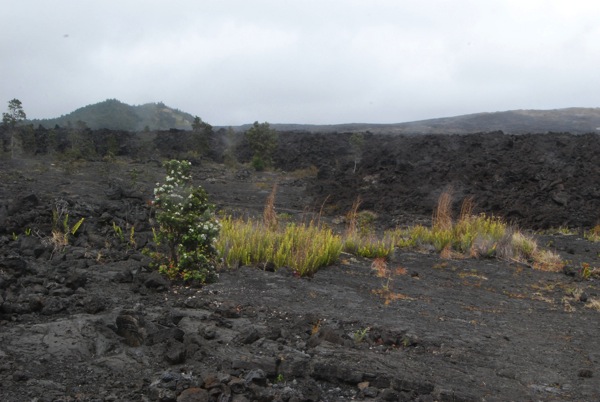
There was green here. The slopes were green. Green grass was growing on the ground. And trees and shrubs. But there were periodic reminders that this was not always a pastoral place. The grasslands were punctuated by black flows of cooled lava. In places the land was scraped clear by it with scraggy shrubs poking up here and there and maybe a lone surviving tree standing on high ground in the distance.

DSC 8293 DSC 8295

We parked the Jeep and walked a bit. Then we got back in and tested the four wheel drive for the first time, almost getting stuck between 4L and 4H in a low area. And then we resumed our climb up Saddle Road.

PanSTARRS

Fri, 15 Mar 2013, 09:52 AM (-06:00) Creative Commons License

1. Look In The West

There was something beeping in my pocket — a faint, hard-to-hear sound, like a vague reminder of something I’ve forgotten to do. I snapped out of my fajita-taco-consuming euphoria and pulled out my phone.

“Look in the west,” Susan said, “the comet it’s…” And the connection dropped.

I walked around the corner of the building and peered into the western sky. A thin slice of a crescent moon hovered above the silhouettes of the trees. A dim glow lingered on the mostly hidden horizon. The parking lot lights glared and made the darkening sky hard to see.

No comet. Maybe it was behind the trees by now.

2. Dirty Ice Rocks

“I thought you might enjoy some pictures of dirty ice rocks in the sky,” Aaron emailed.

He included four attachments.

Against a darkening blue-black with a pitch black silhouette of the Davis Mountains, the comet smeared an orange-yellow tail across the sky. Somewhere just below the curving line of the mountaintops, the sun was shining, it’s light reflecting off those dirty ice rocks that he had captured with his camera.

3. A Morning Off

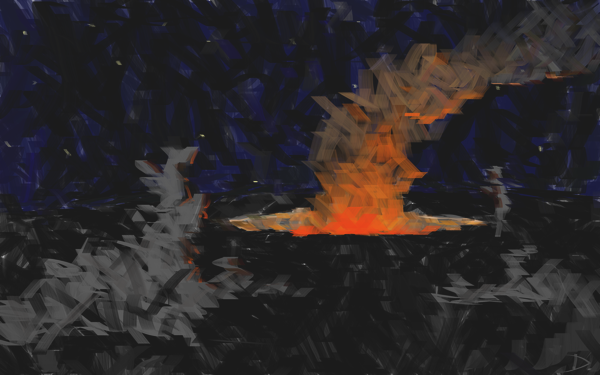
On a Friday off from work, with day rising in the east and an orange glow on the trees and the breeze of day beginning to stir, I sat down and took the stylus in hand and threw down some bits.

I never saw it. But I drew it. Does that count for anything?

Pan comet

Let’s Get Going

Wed, 13 Mar 2013, 09:56 PM (-06:00) Creative Commons License

Let’s continue the Hawaii story, now running on perilously close to a year in the telling!…

1. Driving By The Airport

From satellite you can see it. A black fan of lava running down the slopes of the island into the sea. Kekaha State Park is on its northern edge. Kona Airport is on the south. And Queen Ka‘ahumanu highway runs thru it. 

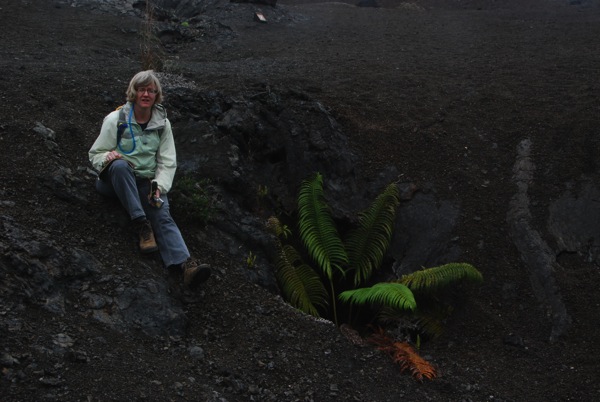
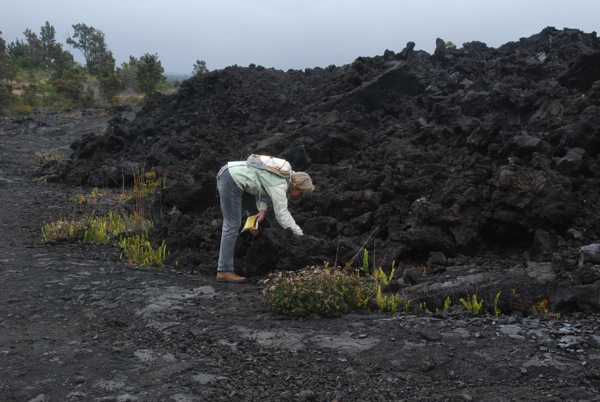
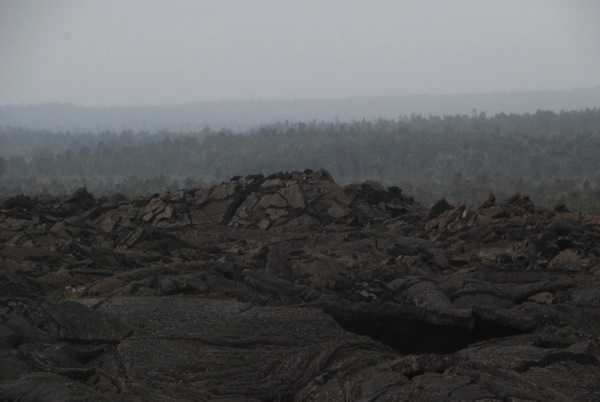
As far as we could see up the slope to our right and as far as we could see toward the ocean to our left, there was nothing but black wasteland. And wasteland does not do it justice. This was a land of piled up, pitch black lava. Great dumptruck loads of it, it seemed. One after another, as if some great expanse of highway somewhere had been ground up and dumped in this place for disposal.

Certainly mother nature would have no cause to create something like this. Piles of sharp black stuff as far as the eye could see. But look at it from a satellite view, and there’s no denying it. Dump trucks were not involved. Mother nature did indeed create this vast, sharp, forbidding, black, desolate, bleak, withered, pile-after-pile of a place.

Black wasteland b

2. On The Beach

The fair and industrious Trudy had a map in her lap.

“Here it is,” she said after we’d been driving a while, pointing to a road that ran toward the ocean. “This must be it. Turn here.”

We drove along yet more barren land, although the black had given way to brown. And we came to a dirt lot where other cars were parked.

An obvious path led toward to the shore. Out of the sun. Past a place drinking fountain where we stopped for a moment. Into a woods that sprang up out of nowhere. With soft ground under our feet.

There was a breeze blowing in the tres. There was a blue lagoon with rolling surf washing up on a sandy shore. Just yards from that unforgiving wasteland, we had entered a gentle world of greens and blues.

DSC 8254

We walked in the shade along the beach looking for a sign of the petroglyphs. And not finding them, we sat for a while and watched the waves washing up on the shore. And then Trudy looked at her watch and wondered aloud if we needed to keep going, because we had a long drive ahead.

3. Climbing Into The Saddle

Today was Kona. Tonite would be Volcano on the other side of the island. Our route would take us along Saddle Road, which the guide book had cautioned us about but the Jeep rental guy had encouraged us to take. This is the road that cuts across the island between the peaks of the two volcanos. We didn’t know what to expect, so we left behind the blues and greens of the bay and returned to the Jeep.

Lunch was in Waimea, a funny little sandwich shop that we were grateful for. In the middle of town, we turned right and drove across highlands and eventually came to our objective: a two-lane asphalt strip that disappeared into the distance.

DSC 8268

The harsh lava wastes were behind us. The beaches and breezes were behind us. Here clouds descended down upon us and surrounded us in a thick fog. Wisps of it drifted across the chaparral. As our Jeep began the gradual climb, the fog got thicker. 

DSC 8272

Somewhere out there off to our left was Mauna Kea. And somewhere out there off to our right was Mauna Loa. We could see neither. At times, we could barely see the telephone poles beside the road.

Culture Day

Tue, 12 Mar 2013, 08:18 PM (-06:00) Creative Commons License

There was Japan and Korea and Vietnam. There was England and Spain and France. There was Mexico and the USA. There were people dressed up in shiny dresses. There were tasty ethnic snacks. There was a guy playing folk songs on an acoustic guitar, and several classrooms down the hall there was another man playing the blues on an electric one. And there was a place in the hall with comfortable pillows spread in an arc around a man with a book.

“Welcome to Jabberwock,” he said.

Some kids stared back. Others’ faces lit up.

“I’m sad to say, we don’t have snacks,” he said. “What we’re going to do is poetry.”

They didn’t seem too disappointed about the snacks, and their reactions to the word poetry were certainly acceptable, so he figured he had a good audience. Indeed, he knew well that at this school, with these teachers, the students were certain to be a good audience, even for poetry.


‘Twas brillig and the slithey toves did gyre and gimble in the wabe, he began.

After several stanzas of this he stopped. They talked about the poem. There was a monster in a forest, the kids told him. And a boy, they said. And a sword.

After a while, he leaned toward them and started over.

Il brilligue. Les toves lubricieux se guirrent en vriant dans les guaves.

Their eyes went round. They laughed stifled laughs, not sure if the ring of the French was something they could or should laugh about. The scooted back and forth on their pillows. They stole furtive glimpses of each other as the monster and the forest and the sword went by, with pantomime gestures to give them clues to the action.

And then after that, he leaned forward again.

Es brillig war. Die schlichten toven wirten und wimmelten in waben.

At this, even the boyest of the boys sat up. Some tried to mimick the –ch sounds as the monster and the forest and the sword went by yet again.


“Did you do this two years ago?” one of the fathers asked later.

“I did,” the man said.

“My older son was in fourth grade then. He said this was his favorite part.”

Even without snacks, the man thought. What validating feedback.


At the end of several hours, long after the snacks were gone and all the students had made their rounds from Japan to Mexico to Spain to England to … Jabberwock, the teachers lined the kids up on both sides of the hall and lined the parents up single file and had them run the gauntlet between the kids. 

The kids cheered as the parents walked by. And they clapped. And they smiled. And they high-fived. And the smiles on the parents’ faces, oh you should have seen their smiles … and the smile on the face of that man.

Palm Trees

Sun, 10 Mar 2013, 07:58 PM (-06:00) Creative Commons License

Although the race the day before conspired to minimize the potential of our free breakfast vouchers, today there was no such constraint. Oh no. Today we could take leisurely showers and then head downstairs to enjoy the eggs and bacon and oatmeal and bagels and pancakes and fruit and coffee to our hearts’ content.

So we sat there enjoying breakfast to our hearts’ content, ignoring the monsters on the wall.

DSC 0580bDSC 0579b

On the far side of the dining room, there was an indoor garden with various low-growing tropical plants and two tall Palm trees (this was El Tropicano, after all) growing up into a skylight that projected beyond the ceiling into an outdoor swimming area on the second floor.

And there were six guys standing around.

No. These guys were definitely not standing around. The were digging with shovels and swinging picks and pounding the ground with a rockbar. Not standing around.

What are those guys doing?

We watched them as they labored mightily, digging a circular trench around each Palm tree.

They’re taking out the trees.

We had seen the trees thru the skylight a few minutes before from upstairs. Their foliage was pressing against the glass. They had outgrown their home. And these guys were digging them out. As it happened, they were transplanting them. The gardener explained that there were two large planters upstairs beside the pool, and they were going to move the Palm trees up there.

You’re going to take them upstairs?

Yes, Their plan was to dig them out and take them up the sweeping spiral staircase that led from the lobby to the second floor pool. But there was a lot of hard, backbreaking work to be done before they got to that point. And we had more of San Antonio to see. So we had to leave the action behind.

Later that day, we returned to the hotel. We had some vouchers for coffee and snacks, so we were stocking up before we started our drive home. As the fair and industrious Trudy surveyed the snacks, I turned to look at the planter where the men had been working that morning. The Palms were gone; a pile of dirt was sitting on a tarp beside where they used to stand; and a woman was sweeping the staircase.

I turned to the barrista behind the counter and asked about the Palm tree procession. One after the other, the barrista said, the six men carried each Palm tree up the spiral stairs.

“I hate to see them do that.”

It wasn’t clear what the barrista meant.

“I mean, are you kidding me? Six of them carrying a tree up the stairs?”

It wasn’t clear what the barrista meant.

“I’m Mexican, too,” the barrista said. “Those six guys can do better than that.”

Probably true. But given the care of their digging and picking, I don’t think the trees could have asked for any better.

La Bamba

Thu, 7 Mar 2013, 08:01 AM (-06:00) Creative Commons License

Across the river there were tables lined along the Riverwalk. They had Texas flag umbrellas over them. The staff walked back and forth in cowboy hats. We were glad we were not over there.

It’s not that we have anything against flags or hats. It’s that it was chilly, and that side of the river was in the shade, while from our vantage point at Café Olé, we sat in a warm puddle of sun.

And as we sat there eating chips and queso and drinking our drinks and waiting for our fajita feast to arrive, three mariachis walked up and down the aisle, sometimes stopping at a table to play a song. Far better than Texas flags and cowboy hats, we were thinking but the mariachi music was just perfect. What could be better?

Better, indeed. After the mariachis had been strumming their guitars and singing for a while, they wandered by our table. One of them looked at me, and I nodded.

“We usually charge $20.00,” he said, “but today we’re just asking for tips.” And he asked if we had any particular requests.

“Well,” I said, “I don’t have a request, but it’s my wife’s birthday today.”

“So something festive?” he asked.

“Something festive!”

The three of them looked at each other briefly, and one of them said something briefly, and then they instantly erupted in song.

Para bailar La Bamba
Se necessita una poca de gracia
Una poca de gracia
Para mi, para ti, ay arriba, ay arriba
Ay, arriba arriba
Por ti sere, por ti sere, por ti sere

The three of them sang loudly and joyfully, one of them sometimes leaning over to emphasize a lyric in Trudy’s ear. I laughed. She smiled. And the warm sun shined. 

© jumpingfish by David Hasan is licensed under a Creative Commons Attribution-NonCommercial-ShareAlike 4.0 International License