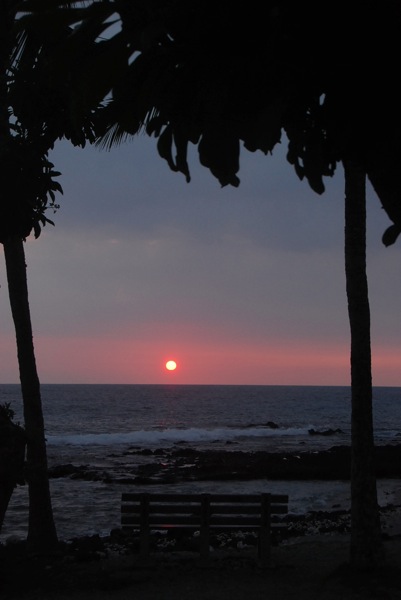
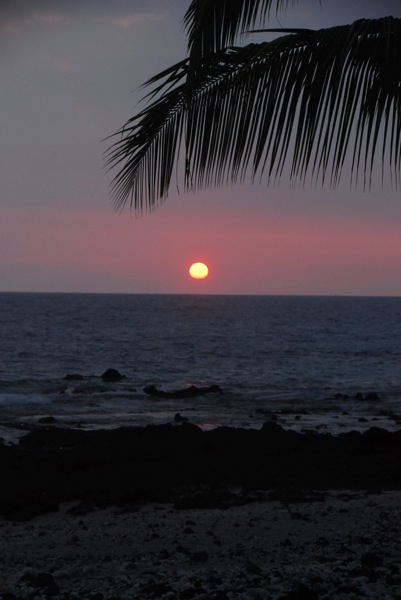
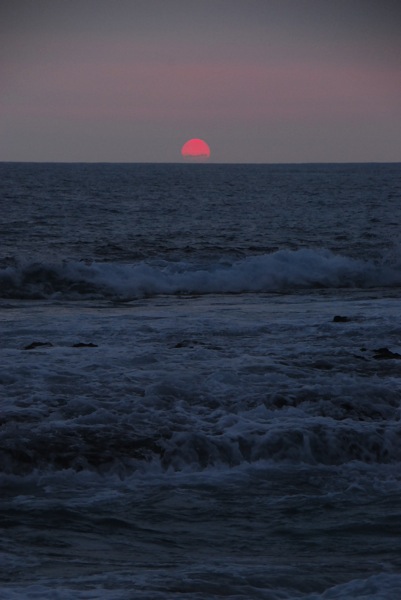
Near Kealakekua Bay.

Where Captain Cook landed during the height of Makahiki in January 1779. And where we went snorkeling from the deck of the Fair Wind II in April 2012.
Near Kealakekua Bay.

Where Captain Cook landed during the height of Makahiki in January 1779. And where we went snorkeling from the deck of the Fair Wind II in April 2012.
The sky was blue. The day was warm. Sunlight glinted off aquamarine water. We sat on the salt-and-pepper beach gazing up the slopes at rain clouds hugging the forest on the mountainside.
It was low tide. The water was far from the sandy shore, and we had to clamber over sharp, black rocks in our flippers to get to the edge.
We swam along the contours. The swells lifted us up until it felt like flying. And they pushed us down to where darting fish and neon anemones hid in crevices and nooks and crannies. After swimming along this way for a while, we would get disoriented and poke our begoggled faces above the water to see where we were.
And as we swam there, a sea turtle passed us by.
Trudy looked back at me, her eyes wide, her finger pointing. I nodded, and we swam a while alongside as the turtle in great sweeps of its fins glided along the counters and rose and fell in the swells on its way to someplace that it seemed to have in mind. We swam alongside, keeping our distance, until the water got shallower and the swells threatened to push us down onto the rocks.
The sea turtle, it kept going.

Before we drive off, one more from Pu‘uhonua O Honaunau:

Ranger Kalehua gave a good talk. He told a good story, and he kept his audience involved in the telling of it. In fact, Kalehua had a knack for spotting people in the audience who might make good targets and pointing to them and saying, “Quick, what’s the name of this place?”
Pu‘uhonua O Honaunau
He picked on the kids, who relished it. He picked on dads standing off to the side. And he picked on…
“Are you going to embarrass me?” Trudy asks.
“No,” I say.
Let’s say that Kalehua had this knack for calling on people whom he must have been certain would tie their tongues in knots trying to speak the name of that place. And well, since I promised not to embarrass the fair and industrious Trudy, let’s just say that she got a fine braided Ti-leaf as a prize.
A place of black volcanic rock. Stark against the blue ocean. Black walls of ancient temples at the southern end of Honaunau Bay. Pu‘uhonua O Honaunau National Park. (Say that three times fast!)

This was our main destination for the day. And we timed it well without knowing it, because just after we got there, Kalehua, a park ranger was scheduled to give an afternoon talk. He’s been a ranger there for 25 years, but he says he wishes he started earlier.
Kalehua told us about the place. About the migration of Polynesian people to Hawaii centuries ago. About the four gods, Ku, Lono, Kane and Kaneloa. He told us about kapu (tabu) that governed Hawaiian society. About death to anyone who broke it. To anyone who looked at a chief. To anyone whose shadow fell on royal lands. He told us how the kapu were absolute.
“No misdemeanors,” he said, “only death.”
And he told us how this place… And at this point, he’d stop and say, “Quick!” and point to someone in the audience. “What is the name of this place?” awarding a braided ti-leaf for a correct answer.
He told us how this place was a temple of refuge, a place of forgiveness for anyone who broke the kapu. Forgiveness, that is, if they could reach the sacred grounds by swimming across the bay and clambering up the sharp rocks on the shore before their executioners could catch them.
Today, a long wall and several platforms mark the place. The water of the bay still laps on its rocky shores. And sea turtles take refuge in the shallow tidal pools.

But the chiefs and their kapus are gone.
Highway 11 on the Kona coast is extremely narrow there. The mountain rises up on the one side and drops off steeply on the other side of the two-lane road. Yet just beyond The Coffee Shack there was a narrow pull-off on the narrow shoulder where two cares were parked. Evidently this was the overflow lot.
“Pull over here,” Trudy said, pointing to a space in front of the second car — a narrow triangular space barely long enough and barely wide enough for a car to fit. Perhaps she thought her husband would just whip their rental Jeep over and pull into that tiny spot. Or maybe she thought he’d back into it.
Right.
His first day of driving that Jeep, and he was going to parallel park along the edge of a precipice 1400 feet up the summit of a volcano with a vertical drop awaiting any tire that strays just a bit to far?
He passed the spot and found a place further down where he could pull off the road on the other side, the mountain side, of the road. And they walked the quarter mile or so back to The Coffee Shack and ate sandwiches and drank Kona coffee as the gazed out the windows down the steep slopes of the mountain out toward the ocean.

Blue sky. White clouds roll by. Cool breeze blowing off the ocean. Deep blue waters. White waves breaking on black rocks. And oh my gosh, would you believe it? There goes a Hawaiian catamaran under sail. Two yellow hulls kicking up whitecaps. A brown-orange sail full with the wind of the deep blue sea.
Why are you writing about that?
I don’t want you to do anything.
I mean, come on. I know that last spring you had a vacation there and all that. But puffy clouds and breezy breezes and a boat sailing by. Really, what’s the point?
No point. I’m just writing about it, because it was cool. We were out there with the breeze from the ocean in our face. The sky and water were shimmering in these hues of blue I never thought I’d need to describe. And as we’re standing there, this catamaran sails by with the white froth of its wake trailing behind it, with the triangular sail full of the wind. Do what you want with these words, man. You don’t even need to read them, but I tell you, the blue of the sky and the deep blue of the ocean and the bright yellow of the two catamaran hulls was something to behold.
Sheesh. Next thing you know, you’ll be uploading a silly sketch.
That’s a fine idea.

Sorry I mentioned it. And FWI, the sail isn’t brown-orange.
Whatever.
And so how does it work with these … verandahs, these big Hawaiian porches, these lanais? These open patios with great flat ceilings to shelter you from the rain or bright sun but otherwise open to the elements. I’m not even sure what you call these places, and I certainly don’t know how they work.
What happens during a storm? Do they take all the furniture away? Do they nail it down? All the tables and chairs and comfortable couches. Do they throw tarps over it to keep it dry?
Or does the rain just mostly fall straight from the sky, leaving everything under these roofs dry? That would explain why the ceilings extend so far out. But seriously, does the wind not blow when the rain falls? And what about the front desks and the paper on the counters and their computers and telephones and things? What happens to them?
It was like this at the airports in Honolulu and Lihue and Kona. It was like this at The Islander in Kapaʻa. And it’s like that here. I just don’t understand it. And it’s so wonderful.
(Part of the ongoing telling of our Spring 2011 trip to Hawaiʻi.)
It’s been eight months since we went to Hawaiʻi. But the story isn’t completely told. I still have scribbled notes in this Moleskine. So forgive me, but it’s winter and, well, I’ve got these notes, so I’d like to pick up where we left off, on the Big Island…
We’re in the hotel room. The surf is washing up on the beach outside our window. I just took a hot shower, and oh how wonderful it is to no longer be sore from our hikes in Kauaʻi. The fair and industrious Trudy is trying to figure out why a picture she posted to Facebook didn’t appear.
We go to the (free!) breakfast downstairs at the breakfast buffet. The reviews dissed this spread!? It entirely meets with our approval (om nom nom).
Now we’re back in the hotel room again. We’re supposed to be gathering our snorkel gear and heading out, but Trudy walks straight over to her computer.
“Whatcha doin’, Trudy?”
She brings up Facebook.
“Oh oh,” she says. “Steve can’t see the photos. I need to change some settings…”
I go to brush my teeth. When I come back out, Trudy proclaims, “Linda likes my photos!”
It’s only been ten seconds since she changed her Facebook settings, and people are liking her photos. She has a proud smile on her face.
So with the winter solstice passed, a cold wind has come down from the north. The mid-70s of last week are gone. The faucets are wrapped and the spinach beds covered.
The lizards and beetles and snakes and other creatures of the earth are hidden in their warm places, maybe under the logs in the back or under the brush pile in the corner or maybe under that scrappy pile of logs and brush out front that in the summer is hidden by Salvia and Sage but is about to be revealed up and down the street as the greenery freezes and falls to the ground and the scrap is laid bare for everyone to see.
The cold, grey clouds broke this evening just as the sun went down. And for a moment the chill of the wind around us went away. The sky lit up orange-red in the west, and wisps of cloud overhead burst alive in electric pink against a pastel blue.
“Wow,” I said. “Just look at that.”
Even the woman in the Pearle Vision store walked to the window to admire it.
The sky.
It has been two months now since a single drop of rain fell from the sky. This should be our rainy time. Yet our two brand new 200 gallon cisterns stand empty on the side of the house.
It is cold tonite, and the air is bitter outside. But the real fright is the blistering dry summer that lies before us.
Still, for now … winter.
© jumpingfish by David Hasan is licensed under a Creative Commons Attribution-NonCommercial-ShareAlike 4.0 International License