Skip to content

Yelling, Singing and Making Statements

Sun, 9 May 2010, 08:52 PM (-06:00) Creative Commons License

It was the day of the fourth grade Culture Fair.  Mexico and Japan were in one room.  India was across the hall with Britain. There were tamales and wasabe and soy beans in a pod.  And hot chai.

The kids were organized into small groups of 6-10 boys and girls, and every 18 minutes they’d rotate from one country to another.

My country wasn’t a country at all.  I had some pads and rugs set out in front of a table where the kids could sit, and I recited a poem in three languages.  On the map on the wall that showed what countries were in what rooms, my country was Jabberwocky.

‘Twas brillig…

Il briligue…

Es brillig war…

The first group of kids were rolling in laughter during the French.  And they all were wide-eyed at the German. We talked about words in different languages and where they go in our brains and how the same words can sound so different.  We talked about translating from one language to another and how it seems like it should be so straightforward until you try to do it …say… with poetry. And we talked about the sound of The Jabberwocky.

The kids agreed that the sound of the German fit the story better.  “It kind of sounds more like yelling,” I suggested, “where the French sounds more like singing.”  A short-haired boy raised his hand.   “And I think the English sounds more like … like making a statement.”

Not yelling.  Not singing.  Making a statement.  Perhaps that’s just about as accurate a description of English as anyone might have come up with.  …  Or on second thought, maybe my English rendition of the poem needs some work.

Was That a Costly Device?

Wed, 5 May 2010, 07:09 AM (-06:00) Creative Commons License

In 2000, the US government issued said a backup system to turn off deepwater drilling systems was an essential safety component. In 2001, the industry complained that there were significant doubts about such systems. In 2003, the government decided that, what do you know, more study was required.  And the Minerals Management Service reported that the devices are not recommended because they tend to be costly.

The devices tend to be costly.

The device cost about a half-million dollars.  Well that’s costly, isn’t it?  Well…

Cost: The Deepwater Horizon replacement cost is approximately $550 million.  BP is spending more than $5 million per day on the clean up right now, and the costs could grow horrifically if the gusher keeps spewing oil unchecked for months. You tell me: Was that a costly device?

Benefits (risks): Risk is defined as the probability of a failure multiplied by the severity of the consequences should the failure occur. So what is your estimate on the severity of the consequences of filling the Gulf with oil?  Now, you tell me: Was that a costly device?

That and This

Mon, 3 May 2010, 07:36 AM (-06:00) Creative Commons License

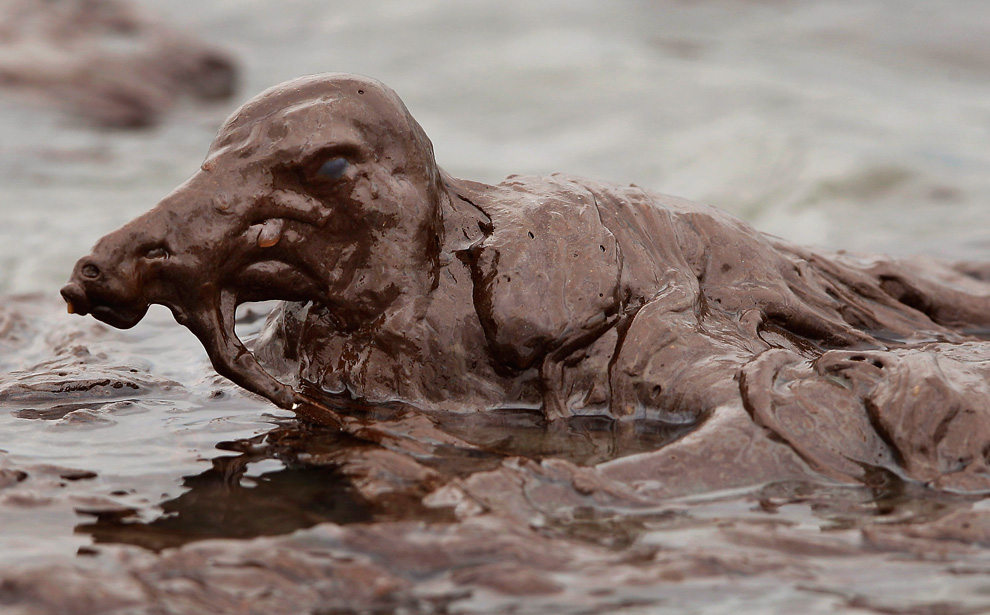
Question: How are you going to do this

gulf_spill_2010.jpg

to this?

gulf_spill_2010.jpg

Answer: You’re not. This one can’t be cleaned up, even superficially.

Gordon Brown v. Gillian Duffy

Sat, 1 May 2010, 02:38 AM (-06:00) Creative Commons License

Poor Gordon Brown. He got caught calling Gillian Duffy a bigot when he forgot to take off a microphone as he drove down the road in his fancy limousine. It was televised live. And now it’s all over the web. You have to feel for the man.

Or not. Because it turns out he is incapable of admitting his own mistakes — incapable of apologizing.

“I apologize if I said anything like that,” he later said.

Excuse me? You didn’t say something like that; you said exactly that. You called her a bigoted woman.

“Of course I apologize if I said anything offensive.”

If indeed. If he said anything that might perchance to be offensive, I say.

“I would never put myself in a position where I would want to say something like that about a woman I’ve met.”

For god’s sake, man, you were caught on tape. You’ve heard it yourself. Just fess up and apologize!

But you see, he can’t. He’s a politician. They don’t know how. It’s not in their DNA.

Drill, Baby, Drill!

Fri, 30 Apr 2010, 05:06 PM (-06:00) Creative Commons License

No technology is perfect. So it’s not a matter of if something will go wrong but rather a question of when. To think or say otherwise is to lie thru your teeth.

For the Mississippi delta, when is now.

Drill, baby. Drill!

Rebooting

Mon, 19 Apr 2010, 05:39 PM (-06:00) Creative Commons License

1989

On the twentieth anniversary of the first Apollo moon landing, speaking at the National Air and Space Museum, President George H. W. Bush said:

Today we don’t have a crisis; we have an opportunity. … I’m proposing a long-range, continuing commitment. … Back to the Moon; back to the future … And then a journey into tomorrow … a manned mission to Mars.

2004

In 2004 while unveiling his new space policy, George W. Bush said:

With the experience and knowledge gained on the moon, we will then be ready to take the next steps of space exploration — human missions to Mars and to worlds beyond.

2010

And last week in Florida as part of canceling the Constellation program Barak Obama professed commitment to manned spaceflight and exploration and said:

By the mid-2030s, I believe we can send humans to orbit Mars and return them safely to Earth. And a landing on Mars will follow. And I expect to be around to see it.

The Thing of It

Obama might expect to be around to see it, but why am I skeptical? Why does this seem like just another kick of the can? Why do I find myself thinking strike three?

The thing of it is, even if this should come to pass, even if there is no more kicking the can down the road, even if we do get there in the mid-2030s, the problem is this: I won’t be involved; I will have been retired for years; I will have spent my whole life waiting. Waiting for something that never happened.

Now don’t get me wrong. Mars itself wasn’t important to me. Frankly it made me roll my eyes. What I’m saying is that there are only so many times you can reboot a machine before you really ought to give up.

Tell me, how many times is that?

40 Minutes

Sun, 18 Apr 2010, 08:59 PM (-06:00) Creative Commons License

“Forty minutes minimum wait,” the woman behind the shuttle van counter said.

“No matter where I’m going?”

“Forty minutes minimum wait.”

I stood there as she watched me and the lady behind me waited.

“Ok,” I said. “I guess I’ll take the taxi.”

She waved outside and to the left.

The automatic doors opened for me and I turned left. As I passed the shuttle van stop, there were indeed people waiting. I kept walking.

Then I came to an empty bench with bright lights overhead. I stopped and looked up at the lights. I turned and looked at the waiting people. And then I went back into the airport to the woman behind the counter.

“I’ve got a book,” I said, “so I’ll just wait the forty minutes.”

She shrugged and rang up my credit card. “Talk to man outside.”

Outside, the man gave me a pager and said, “Come back and see me when this goes off.”

I sat on the bench with the bright lights and got out my book.

But just minutes after I sat down, after only one paragraph, a van drove up, and my pager went off. And the man behind the counter pointed to the van which was full of people with one free seat evidently waiting for me.

The driver took my suitcase and slid the door shut. He drove thru the airport gates and got on the freeway and began driving west as the sun went down. In a few minutes, he pulled up to the first stop on his route and dropped me off at my hotel. I was the only one to get out.

From the time that woman behind the counter told me it would be forty minutes minimum wait to when I was riding up the elevator to my room, a total of 20 minutes had elapsed.

I’m glad I didn’t take the taxi.

Calculus Problems

Fri, 16 Apr 2010, 07:32 AM (-06:00) Creative Commons License

“Hi Dad.”

“Ben!”

“Are you busy?”

“No. I’m at a conference, but we just took a break.”

“Should I call back later?”

“No, no. Now is fine. What’s up?”

“Well,” he said, “I have some calculus questions.”

I thought to myself, well it this really is a call I needed to take! He explained how they’re doing optimization problems, and he proceeded to explain some problems he was working on.

The first problem: find the size of a cylinder inscribed in a sphere that has maximum volume. We talked the problem definition thru and I had him draw a diagram illustrating the relevant quantities, and within a few minutes, he was telling me how to solve it.

Then he described his second problem: finding a maximal volume cone. We talked again about the problem definition and discussed another diagram, and again he was telling me how to solve it in a few minutes.

Finally he described his last problem. This one, I confess, I didn’t master. I needed a pencil and paper and a few minutes to look at the problem and think. In the meantime, we discussed the problem definition, and I had him draw a picture. And as I talked my way in circles, he began to solve it.

And that was it.

“Thanks Dad. Are you having a good time at your conference?”

“Yeah,” I said in a fairly noncommittal tone, omitting that I really wanted to see that paper that was going on then.

“That’s good.”

“What have you been doing?” I asked.

“Studying in the library.”

Music to my ears.

And so that was the end of our conversation. We said goodbyes and I-love-yous, and I went back into Salon-1. As I closed the door behind me, the speaker said said, “And in conclusion…” I chuckled to myself.

That’s ok. I would catch his paper when he gave it again the next day.

Freezing in the Dark

Fri, 9 Apr 2010, 11:54 PM (-06:00) Creative Commons License

I saw a bumper sticker in a parking lot a few weeks ago. It was black with plain white letters: Let Them Freeze in the Dark. I stood there for a moment trying to figure it out.

Then I noticed the vehicle: a large, black Cadillac Escalade hanging over both sides of the parking space and sticking out in back. And then I understood.

3 thoughts…

1. What it meant

The critical clue was of course the vehicle. Any bumper sticker on a shiny Escalade can probably be interpreted thru the lens of the Escalade itself.

I had a trouble interpreting the slogan at first, but upon seeing the behemoth it was attached to, the message became clear.

I got mine, and I’ll be darned if I’m going to give it up. Anyone that thinks otherwise, is a lame, no-good weasel who clearly doesn’t have theirs yet and wants what I got. But I got it, and they don’t, and if they don’t want to drill-baby-drill, well then they’re just gonna be cold all alone, aren’t they, because clearly I won’t, haven’t you figured that out by now?

2. The root of all evil

This is greed is good gone bad.

A total lack of interest in anything other than personal gratification and comfort. A total rejection of any notion of the general good, of society’s interest, of shared values, of civility.

It’s moral relativism at the other end of the spectrum: good is only meaningful relative to the comfort it creates; nothing else matters.

But this attitude is in my opinion the root of all evil today. You’re not the king of me. Only I matter to me and not how I behave toward you. It’s all a game, anyway.

This is nihilism at it’s worst. Nothing is important, so I get to make up the rules. And you better stand back.

Is it any wonder Blankenfineship Lord of Goldman-Sachs, sees his work as the work of god?

This attitude is evil, plain and simple. (And wasn’t the Escalade black?)

3. My corner of space-time

Now in the long-long run, I suppose it is true that nothing matters.

Dust to dust, after all. All is vanity. The sun will eventually go super-nova, and all this will, I admit, be moot. This pontificating. The bumper sticker. The Escalade. The champagne. The greed. The birds in the trees. The flowers in spring. Everything will eventually be moot.

But that is not the frame in which I choose to live my life.

I choose to act as if the ultimate void will never come. As if the birds and flowers are important. As if suffering caused by financial crises is a bad thing. As if poisoning the rivers is bad. As if the mountains majesties matter. As if happiness is a fundamentally good thing.

I choose a subset of the universe in which ethics are relevant even though they might not be in the long-long term. And in that little corner of space-time, I choose to reject everything that that guy in the Escalade stands for not only as wrong, but as gut-bustingly disgusting.

On the other hand, I had a veggie burger that day. He probably had a burger and fries and shake and is going to get what he’s got coming to him, hopefully before I start freezing.

Greenspan 70/30

Thu, 8 Apr 2010, 08:10 PM (-06:00) Creative Commons License

George Greenspan. Wait, is that his name? No. Alan Greenspan, that’s it. Oh, how soon they (want to) forget.

Alan Greenspan testified the other day before the Financial Crisis Inquiry Commission — that august congressional panel that is even now vectoring in on the causes of the financial crisis that brought the nation and the world to the brink.

In his testimony, he talked about two numbers: 70 and 30, the percent of the time he got things right and got things wrong. I want to talk about his use of those numbers.

What I say is hogwash.

This is technocratic mumbo-jumbo, the kind of stuff technical people say when they’re faced with failure but can’t come out and admit it. Instead of fully admitting failure, they cloak contrition in technical sounding language that is meant to snow (or has the effect of snowing) their audience with pseudo-quantitative information that has the effect of creating credibility where there should be none.

70/30 is not credible in my opinion. Here’s why I say that.

Percent? What is he saying when he uses that word. Did he do a study of his decisions? Did he count them up and assess their success? What was his sample size? How did he define “success”? Show me.

70/30? Really. Where are the numbers that yield those nice tens of percents? Get serious; there aren’t any numbers. When asked, “Would you put [the financial crisis] in the 30 percent category?” Greenspan replied, “I don’t know.” I see… you don’t know. So specifically what does go into that 30 percent category?

He was speaking metaphorically, you’ll say. Qualitatively. I say, no. 70/30 is not a metaphor, and do I really need to point out that 70/30 is by definition quantitative?

No, I’ll tell you what 70/30 says. First of all, it says that you’re thinking in terms of tenths — clean, precise tens of percent. 70/30 means nothing if it doesn’t clearly differentiate the speaker’s point from, say, 60/40 or 80/20. Really? So just what is it in his history of decisions that yields 70/30 and not, say, 60/40? Nothing, I suspect.

This isn’t metaphorical. This isn’t qualitative. This is his usual technocratic mumbo-jumbo, and this time it’s designed to distract a nation afraid of numbers from the reality of what just happened.

Greenspan’s contrition would have been more credible in my mind if he had just said, “I made some errors but on the whole they were fewer than my successes.” But that’s not what he said. Because that’s not what he wanted to say. What he wanted to do was construct a narrative in which his tenure at the fed was one of fine-grained control over the levers of a complex system, to project that he was so in control of the financial policy apparatus, so measured in his assessment of the situation, that he can now step forward and state with confidence the percentages on his success/fail ratio to within tens of percent.

Pay no attention to the man in front of the curtain.

© jumpingfish by David Hasan is licensed under a Creative Commons Attribution-NonCommercial-ShareAlike 4.0 International License